
Introduction
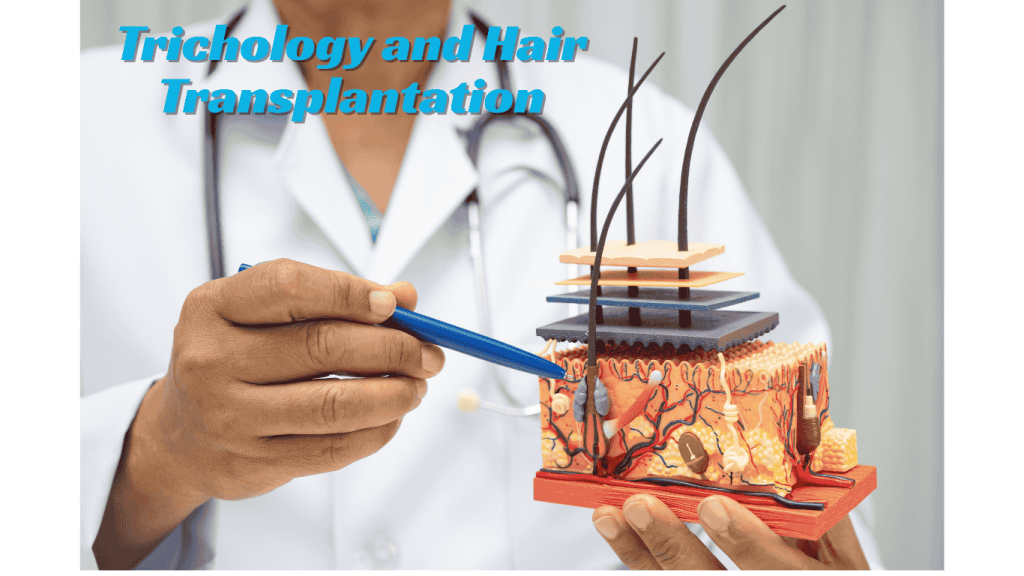
Trichology and Hair Transplantation are no longer a niche form of cosmetic luxury; it has become a medical need. As clinical tests have revealed that almost half of all males and two-fifths of all females have suffered considerable hair loss by age 50, the need to find scientifically that hair restoration is safe medically, and therefore, medically needed have never been more evident. Such disorders as androgenetic alopecia, telogen effluvium, and scarring alopecia are causing patients to turn towards professional treatment as an alternative to over-the-counter treatment.
Medically speaking, after graduating, it will be a wise career step to enrol in a special Trichology and Hair Transplantation Course in Delhi. Through the master trainee program at ILAMED under Dr. Ajay Rana, the practitioner teleports to the top of this fast-growing field of medicine through a thorough training program that bridges this gap between dermatological diagnosis and surgical precision.
What does Trichology and Hair Transplantation involve?
It is a dual-disciplinary method in aesthetic medicine that involves medical science of the scalp with sophisticated surgical treatment.
Hair and Scalp Disorders Diagnosis and Treatment.
Reason: This is something more than mere hair fall. It uses dermoscopy of the skin to diagnose diseases such as the Seborrheic Dermatitis, Psoriasis, lichen planopolaris, and nutritional deficiencies. Proper diagnosis will avoid an unwarranted surgical process and will promote medical care where it is required.
Surgical and Medical Hair Restoration.
Explanation: The curriculum differs between medical management (finasteride, minoxidil, peptide serums) and interventional procedures. Students get to know when they can prescribe a topical solution and when they can prescribe a Trichology and Hair Transplantation surgical course.
Knowledge of Hair Biology and Growth Cycles.
Elaboration: A thorough discussion of Anagen (growth), Catagen (transition), and Telogen (resting) stages. Such knowledge is essential not only to time treatments such as PRP, but also to predict the post-transplant shock loss to effectively address patient expectations.
Important Elements of the Field:
Trichology: The science of hair shaft and scalp. Hair Transplantation: This is the surgical process of placement of healthy DHT-resistant follicles of hair in the donor area and transplantded in the recipient region. This is what renders Trichology and Hair Transplantation an essential skill of the contemporary aesthetic physician.
Why attend the Trichology and Hair Transplantation Course in Delhi?
Intellectually unquestionably the most popular place to get education on hair restoration in India is Delhi, which possesses a kind of exclusive ecosystem of volume of patients and high levels of surgical training.
1. Advanced Clinical Exposure.
Explanation: ILAMED offers an experience of high volume OPD where students observe a large range of cases, including patients with Norwood 1 stage infection, and patients with Norwood 7 correction cases. This is exposure to the real world complication that is indispensable in the development of diagnostic acumen.
2. Mentorship by an Expert under Dr. Ajay Rana.
Exploration: Hair high transplant is a millimeter ago art. To know how to work the ergonomics of graft placement, the angle of incision, how to make the hair line aesthetically designed, one needs a mentor who has a thousand cases. The tips on avoiding cobblestoning and attaining natural density taught in the class are guaranteed to the students by Dr. Ajay Rana.
3. Comprehensive Hands-On Training.
Explanation: This program focuses more on practical implementation as opposed to un-practical observational courses. Particular practical modules consist of: FUE Techniques: Explanation: FUE has been found to master motorized punch extraction without cutting (slicing) the thin follicle bulb. PRP Therapy: Training: Centrifuge guidance and injection (nappag vs. bolus) to release growth factors optimally. Scalp Analysis & Dermoscopy: Explanation: This is a measurement of follicular unit density, perifollicular inflammation and hair shaft diameter with digital trichoscopy.
4. Surging Industry Demand.
Rationale: Indian hair transplant market is estimated at hundreds of millions of dollars; and the tourism of medical treatments generates interest among the international community. Having graduated a Trichology and Hair Transplantation Course in Delhi will place one in a better position to attract local and international traffic and patients who are willing to get the high-quality care at reasonable cost.
ILAMED and Dr. Ajay Rana about ILAMED.
Ilamed has developed a strong reputation of being an excellence center of aesthetic and surgical training. The institute is reputed in the field of Trichology and Hair Transplantation through:
International Curriculum Standards:
Description: The syllabus complies with the recommendations of the International Society of Hair Restoration Surgery (ISHRS), and global standards exist in terms of graft storage, infection, and anesthesia.
Practical-Based Learning:
Explanation: The program will be organized in such a way that live surgery will be observed and assisted with grafting. Students are taught how to critically workflow through donor area marking and tumescent anesthesia to sort grafts on a magnitude.
Certification with Credibility:
Explanation: A Credential granted to ILAMED in Hair Transplantation certifies a clinician to safely and ethically carry out the procedure.
Participants who have worked under the mentorship of Dr. Ajay Rana acquire not just technical dexterity, but clinical wisdom. His style puts a focus on patient safety, ethical practice and the need to set realistic aesthetic results.
Trichology and Hair Transplantation Course Curriculum (Structured Learning)
An efficient Trichology and Hair Transplantation program is separated into separate and progressive learning units.
1. Theoretical Foundation (The Science)
Hair Anatomy and Physiology: Freetion: Thorough histology of the follicle, the bulge area (stem cells) and the involvement of the Dermal Papilla in growth signaling. Hair Growth Cycle Disorders: Presentation Data: The problem with telogen effluvium occurs in the absence of androgenetic alopecia, but there are conditions in which it becomes permanently established. Causes of Hair Loss: Explanation: Differential diagnosis inclusive of nutritional deficiencies, hormonal disorders (PCOS, Thyroid) and autoimmune diseases such as Alopecia Areata. Patient Assessment and Photography: Description: Objective evaluation and medico-legal recording Standardized clinical photography and Norwood-Hamilton/Ludwig scale classification.
2. Practical Training (The Installation)
FUE (Follicular Unit Extraction) Techniques: Explanation: Practice in micromotor and hand punching. Between the selection of the punch size, depth control, and reducing the rate of follicle transection, emphasis is given. PRP (Platelet-Rich Plasma) Therapy: Thought background: The science behind growth factors. Training will consist of blood draw technique, double-spin centrifugation procedures and pattern of mesotherapy injection to rejuvenate the scalp. Scalp Micropigmentation Basics (Optional): Explanation This is an overview of what tricho-pigmentation is, as a form of non-surgical camouflage in scarring or density augmentation.
3. Higher Surgical procedures (The Artistry)
Hairline Design: Explanation: This is the most important aesthetic factor. Pupils are taught to create age-realistic, irregular hairlines using micro irregularities and point closure at the temples that appear natural, and not pluggy. Graft Extraction and Implantation: Consideration: The tedious procedure of 1, 2, and 3-hair follicular units. It is trained how to use the implanters (Lion Implanters vs. Forceps) in order to track the proper angle and to angle direction of the growth. Post-Operative Care and Complication Management: Explanation: Details on how to deal with swelling, pain, necrosis, and the much feared, overharvesting of the donor area.
Categories of Hair Transplant Procedures covered.
Both primary methods of surgical restoration have indications, and a comprehensive course is a part of a training on them.
FUE (Follicular Unit Extraction).
Rationale: This is a non-surgical procedure that requires the removal of follicles individually at the back of the scalp. The course highlights the advantages, which include no linear scar, quicker rate of recovery, and applicability to patients with short hair. It is the present gold standard in the industry.
LFT (Lifeline Follicular Transplantation).
Explanation: The classic (Strip Method) in which the excised scalp is a thin strip that gets excised and then sliced under the microscopes. Students get to understand the relevance of this with patients who require many more grafts per session or with particular types of hair where BIFU transection is more likely to happen.
Both of the techniques have the status of being the cornerstones of Trichology and Hair Transplantation training where the surgeon can customise the approach to the anatomy of the patient.
Profession Scope After Trichology and Hair Skin grafting.
It is a highly linear and financially rewarding career path in contemporary medicine, and this specialization has had its share of such.
Hair Transplant Surgeon.
Reason: In the case of surgeons (MBBS, MS/DNB, MDS Oral Surgeons), a trained surgeon can apply the same education to be in charge of the surgical team at a high-end clinic or hospital doing 1,500-3,000 grafts per day.
Trichologist.
Explanation: An expert that deals with medical (non-surgical) part. This position will encompass the management of chronic scalp diseases, prescription of cosmeceuticals, and diagnostic dermoscopy.
Aesthetic Clinic Practitioner.
Rationale: To add the use of hair loss therapies (PRP, GFC, Mesotherapy) to an already existing cosmetic practice (Botox, Fillers) to grow the company revenue per patient and provide holistic patient care.
Hair Restoration Consultant.
BMW: Small business role, evaluating the eligibility of patients to surgery, coordinating the consultation procedure, and medical ethics is adhered to when making sales.
Market Insight:
By the next few years, market hair transplant is expected to reach a growth of more than 20 percent with a CAGR due to medical tourism in India. One of the highest paid in the aesthetic industry is the Trichology and Hair Transplantation specialists.
The Question: Why to Learn Under Dr. Ajay Rana?
When it comes to having a hair restoration, you become what your mentor is. Dr. Ajay Rana offers unique learning benefit.
Clinical Expertise in Complex Cases:
Explanation: Dr. Rana is often referred to when it comes to repair surgeries- to repair failed transplants, unnatural hairlines cosmetic surgeries performed in other locations. Studying with him educates students on possible traps to forestall such complications.
Practical Exposure to High-Volume Surgery:
Explanation: Visiting and working in a high-volume surgery setting programs the skills of time management and endurance that are required when working in the hair restoration industry.
Industry Recognition and Credibility:
Explanation: A certificate with the name of ILAMED and as tutor of Dr. Ajay Rana is a sweet certificate. It also guarantees future employers and patients that the surgeon has been trained to the utmost standards of safety and aestheticism.
The question is, How to Select the correct Trichology and Hair Transplantation Course?
The choice of the appropriate training program is very important because it is not a skill that is learnt by reading.
Faculty Knowledge and Surgical Volume:
Interpretation: Ask the mentor about his surgical volume. The depth of experience that a high-volume surgeon such as Dr. Ajay Rana possesses cannot be provided by a mentor who only practices a number of cases per month.
Practical Training Exposure (Live Surgery):
Explanation: See to it that the course is ensured to be live with surgery observation. Do not use the programs based only on the tapes of videos or just dummy scalp models. Trichology and Hair Transplantation involves the need to have real-time information in terms of decision making.
Certification Value and Alumni Network:
Explanation: Determination Check whether the institute assists in obtaining a position or helps in finding peers to discuss cases in future. The vast alumni network that ILAMEN has has an immense benefit to new graduates.
Infrastructure and Technology:
Explanation: The institute ought to possess high-magnification microscopes to dissect FUT as well as possess the most recent generation of micro motors to make FUE. Older equipment results in low graft survival.
The Most Commonly Asked Questions (FAQs).
1. What is the duration of the course?
Reason: The length will be determined by the level of training. A three- to five-day basic Trichology and Hair Transplantation course can be followed, and a more in-depth Fellowship should span a few months of surgical training over modules and weekends to suit practising doctors.
2. Who is eligible to study in this course?
Reason: It is a medical procedure. Only eligible allopathic doctors (MBBS) and dental surgeons (BDS/MDS) who are licensed to carry out simple surgical procedures and give local anesthesia can use it. This training is of special interest to dermatologists (MD) who want to further their practice.
3. Is it possible to use live patients?
Explanation: Yes. This can not be compromised in a good Trichology and Hair Transplantation Course in Delhi. Training is at hands-on level, observing senior surgeons and learning about the sterile surgical procedures first-hand.
4. What is the cost of the course?
Description: Investment is dependent on consumables (grafts, punches, PRP kits). Due to the high price of disposables and small student to teacher ratio necessary to safely train students in surgery, courses are charged at a high price. It can be best considered an investment in a high-revenue surgical skill.
5. What job prospects are there?
Description Various options are possible: Graduates can readily incorporate hair transplantation practice into their current practice, work in a surgical unit of a multinational aesthetic surgery chain, or create a specialty-focused hair implant clinic.
Conclusion
The area of Trichology and hair transplantation is a meeting point of medical knowledge, accuracy of surgery and beauty ideas. As more and more people suffer the signs of hair loss, the requirement of professional, competent and ethical practitioners will increase even more. Through doing a Trichology and Hair transplantation course in Delhi with ILAMED and under the invaluable guidance of Dr. Ajay Rana, medical practitioners do not acquire knowledge of course work but rather learn how to become a master of the act. This education offers the assurance, qualification and clinical abilities to not only grow the hair, but the trust of the patients, as well as develop a successful next-generation career in the field of aesthetic medicine.