Unlock Flawless Skin: Secrets from the Best Dermatologist in Delhi
April 8, 2025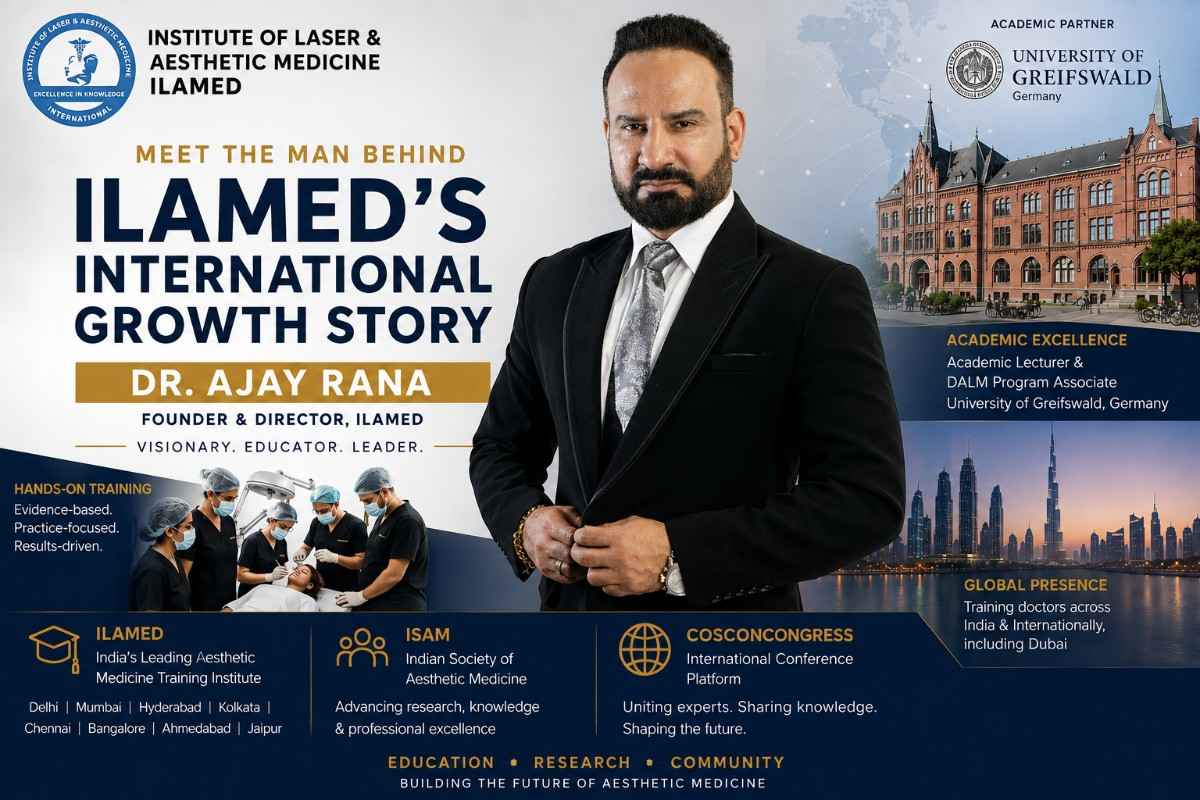
Dr. Ajay Rana Meet the Man Behind ILAMED’s International Growth Story
August 17, 2026
Introduction: History of Surgical Hair Restoration
It is no longer a common belief that hair loss is an unavoidable aging process, but rather a condition that can be treated. As androgenetic alopecia afflicted an estimated half of men and an increasing percentage of women by their 50th birthday, the world has been in search of an effective, permanent, and natural-looking method of restoring hair. Although the old techniques such as Follicular Unit Transplantation (FUT) and Follicular Unit Extraction (FUE) have been used to benefit millions, hair surgery science has not been idle.
Go Lifeline Follicular Transplantation. It is not simply a rebranding of FUE; it is a protocol-based, follicular viability-focused, and micro-designed approach to hair restoration that places the follicular viability and aesthetic micro-design as its highest priority. Lifeline Follicular Transplantation is the next evolutionary step in an era where patients are demanding a quicker recovery, scar-less results, and dense and natural results.
It is a sophisticated process that has been perfected and promoted in clinical ecosystems such as those that are managed by Dr. Ajay Rana and the training centers of the ILAMED where the concept is to combine the precision of surgery with the preservation of biology.
Lifeline Follicular Transplantation: What is it? A Deeper Definition
Lifeline Follicular Transplantation is, in essence, a high-fidelity hair restoration procedure that is advanced. It combines the mechanical advantages of FUE along with improved biological preservation methods. The metaphor of the lifeline is used to denote the period which a follicle is out of the human body – its out of body time – and the process of increasing its viability during this out of body time.
There are three non-negotiable pillars upon which the technique is constructed:
- Maximizing Follicle Integrity - Explanation: The follicular unit is a delicate structure during extraction, which comprises of the bulb (growth centre), the dermal papilla, and sebaceous glands. Any cutting (traction) or crushing of the follicle makes it useless. Lifeline protocols use particular punch sizes and oscillating speeds which are dependent on the hair caliber and curl (C-shaped vs. straight follicles) of the patient to guarantee the follicle is dislodged out of the dermis intact with a protective layer of perifollicular tissue.
- Minimizing Iatrogenic Trauma - Discussion: Trauma occurs in two types: physical (as a result of the punch) and ischemic (due to the absence of blood flow and oxygen). Lifeline Follicular Transplantation focuses on atratumor extraction with special micromotors with controlled torque and special serrated or trumpet punches, which decrease friction and heat production on the scalp. This minimizes fibrosis in the donor area and prevents “shock loss” in the recipient area.
- Ensuring Physiological Hairline Design - Explanation: This is the art aspect. Lifeline protocols are more than a drawn line on the forehead. They encompass the study of native swirl patterns on the hair of the patient, the angle of existing hair emergence (typically 15-45 degrees anteriorly) and the transition zone. The aim is not only to cover the scalp but also to reproduce the irregular, feathered micro-irregularities that make the difference between a transplanted and a natural hairline.
The Differences between It and Traditional FUE and FUT
Although the basic vehicles are FUE and FUT, the navigation system and engine tuning are Lifeline Follicular Transplantation:
- Conventional FUE: The emphasis is on the extraction of separate units.
- Traditional FUT: Attention is paid to micro-dissection of a strip.
- Lifeline Follicular Transplantation: It is centered on Follicle Preservation and Aesthetic Precision.
Why is Lifeline Follicular Transplantation Gaining Ground?
The aesthetic industry is moving towards a not one-size-fits-all FUE strategy, but more patient-focused procedures. This is why this sophisticated technique is gaining popularity among the discriminating patients and the top-notch surgeons.
- Better-looking Final Results (The Illusion of Density) - Rationale: Lifeline protocols only allow the use of micro-irregularities in the hairline construction. The surgeon does not have to make a straight and consistent line of singles, but he forms little peaks and valleys. In addition, the method stresses strategic positioning of the 1-hair grafts in the front shifting to the 2-hair and 3-hair grafts in the back. This resembles the gradient of nature and will avoid the feared wall of hair or dolls hair look.
- Much Better Graft Survival Rate - Elaboration: Follicle death during the holding phase is the most prevalent reason of failed transplants. Hypothermosol (a preservation solution that resembles intracellular fluid) and chilled Petri dishes are strictly considered in Lifeline Follicular Transplantation. Research indicates that storing grafts at 4-8 degrees Celsius can greatly delay the process of cellular apoptosis (cell death). This careful management is able to increase the graft production of the industry average of 85-90 to over 95-97.
- A Truly Minimally Invasive and Low-Downtime Approach - Rationale: The micro-wounds heal in 48-72 hours due to the decrease in the size of punches and the manual torque in the Lifeline approach. Scabbing is also decreased, the redness that follows the operation is also minimized, and the chances of recipient site necrosis (skin death) are also significantly lower. The patients are able to resume a hat free public life much faster than in older techniques.
- Long-term efficacy and donor area management - Rationale: Hair on the safe donor zone (occipital scalp) is genetically programmed to resist Dihydrotestosterone (DHT). Lifeline Follicular Transplantation makes sure that such follicles are not ruined in the process of the relocation. What is produced is an everlasting increasing asset. The precision extraction also reduces the moth-eaten or excessively harvested donor images.
The Biology of Success: The Hair Cycle in Transplantation
In order to fully grasp the subtlety of Lifeline Follicular Transplantation, one has to be aware of the hair cycle chronology and how surgery interferes with it and then reprograms it.
- Anagen (Growth Phase). Description: The active period between 2-7 years. Transplants of the hair are based on the principle that although the follicle is shocked out of Anagen by surgery (Telogen Effluvium), the follicle stem cells are not dead. To guarantee the survival of the stem cells in the bulge area after transfer, lifeline preservation is done, which prepares the cells to re-enter Anagen 3-4 months after the operation.
- Catagen (Transition Phase). Rationale: A short 2-week regression period. Newly transplanted hair shafts tend to fall out as soon as possible (this is normal and expected – called shock loss).
- Telogen (Resting Phase). Reason: 3-4 months of dormancy after transplantation. This is the ugly duckling stage in which nothing appears to take place. Anxiety is prevented by paying significant importance to Lifeline Follicular Transplantation patient education in this phase. The strong Anagen growth ensues following Telogen.
Lifeline Follicular Transplantation Procedure: A Granular Step-by-Step Protocol
The process is a carefully planned series of medical and artistic happenings.
Comparison: Lifeline Follicular Transplantation vs. Standard FUE
| Feature | Standard FUE | Lifeline Follicular Transplantation Protocol |
|---|---|---|
| Extraction Philosophy | Take away intact follicle | Ectopic follicle with maximum protection |
| Graft Preservation | In cold saline | Preserved in special cell-freezing solution (Hypothermosol) |
| Donor Area Management | Random extraction pattern | Mapping to avoid focal overharvesting with the help of a computer |
| Aesthetic Result Outcome | Natural density | Physiological density having micro-irregularities and age-specific recession |
| Graft Survival Expectancy | 85-90% (average) | 95% (because of less out-of-body ischemia) |
| Recipient Site Preparation | Blades or Needles | Graft diameter-matched custom-sized implanters |
Expanded Benefits of Lifeline Follicular Transplantation
- Permanent and Genetically Programmed Restoration. Explanation: The transplanted follicles are of the occipital rim- a region that has no androgen receptors. Thus, although the native hair of the patient may still fall because of the excessive level of DHT, the Lifeline Follicular Transplantation hair transplanted will remain firm forever.
- No Donor Scarring (The Clean Donor). Rational: With sub-0.9mm punches, the scar is a small hypopigmented dot less than a pore. In a Lifeline protocol, the surgeon will make sure that there is a wide gap between these dots so that even a haircut (number 0 or 1 guard) result in a bald donor area.
- Accelerated Social Recovery. Rationale: The less traumatic and accurate implantation result in the small crusts being shed within 7-10 days. Patients may be able to wear a loose cap by day 4, and regain normal grooming activities much more quickly than was the case with strip surgery (FUT) that requires several weeks of suture care.
- Hyper-Customizable Architecture. Rationale: Each face is unique. Lifeline training also imparts the surgeon to manipulate the Temporal Peaks and the Widow Peaks, either to soften or to masculinise the facial structure to the particular aesthetic objectives of the patient.
The Importance of Training and Institutional Expertise
Lifeline Follicular Transplant is a procedure that is highly skilled. The variation between a mediocre outcome and an excellent outcome is the training of a surgeon and clinical ecosystem.
- Institutional Excellence (ILAMED): Explanation: Institutions such as ILAMED offer the framework of this sophisticated technique. They provide organized programs that extend beyond simple FUE workshops. They offer hands-on training on High-Magnification Microscopes to train graft dissection and Advanced Motorized Systems to train extraction to make sure that doctors are ready to work at the necessary speed and accuracy when working with Lifeline protocols.
- Expert Mentorship (Dr. Ajay Rana): Explanation: There is no better learning experience than to be mentored by an experienced professional such as Dr. Ajay Rana. He gives an insight into Complication Avoidance- how to work through the tricky transition areas, how to deal with patients with retrograde alopecia (thinning of the nape) as well as how to deal with an unrealistically expecting patient (body dysmorphia) in an ethical way.
- Patient Safety and Ethics: Explanation: Training on a known protocol will guarantee compliance with sterilization standards (aseptic technique). In the world of unregulated and untested, untrained technicians who operate surgery, the formal training in Lifeline Follicular Transplantation can be the difference between a physician-specialist and a commercial operator.
The Future of the Career Trajectory of Lifeline Follicular Transplantation
Since the market is distinguishing between the low-end FUE mills and the high-end restoration clinics, high-level skills are being paid high prices.
- Aesthetic Clinics: Explanation: Multi-specialty clinics are after surgeons with specialized training on the latest techniques to head their hair restoration departments. A well trained surgeon with the Lifeline protocols can handle 1,500-2,500 graft sessions with fewer complications and this will also enhance the profitability and reputation of the clinic.
- Dermatology Centers: Explanation: A full-spectrum practice is formed by a combination of medical dermatology (treatment of scalp psoriasis, seborrheic dermatitis) and advanced surgical restoration.
- Privacy Practice (The Boutique Model): Explanation: Trained specialists under the tutelage of Dr. Ajay Rana and certified by ILAMED are in a good position to establish the so-called Boutique practices, which are based on quality and not quantity, and target the high-net-worth members who need the best possible result, not the lowest price.
Risks, Reasons and the Significance of Qualified Hands
Although Lifeline follicular transplant is very safe, it is a surgical procedure.
- Temporary Post-Op Edema (Swelling): Explanation: Comes on days 2-4 when tumescent fluid is held by gravity in the forehead and eyelids. Lifeline protocols involve special positions of sleep (head at 45 degrees) to alleviate this.
- Folliculitis: Definition: Folliculitis is an ingrowth of the hairs or a bacterial infection of the small recipient sites. This is uncommon in Lifeline protocols as a result of the “skinny graft” trimming that does not allow burying of epithelial tissue.
Lifeline Follicular Transplantation Frequently Asked Questions (FAQs)
Although Lifeline follicular transplant is very safe, it is a surgical procedure.
- 1. How is Lifeline Follicular Transplantation different from just “FUE”? Explanation: FUE explains the extraction tool. Lifeline explains the whole procedure–how the follicle is grasped, chilled, graded and angled when implanting. It is a quality assurance system used on FUE surgery.
- 2. Can Lifeline Follicular Transplantation be done on curly or Afro-textured hair? Explanation: Indeed, it is absolutely necessary to curly hair. The curly hair follicles are curled beneath the skin (J or C shaped follicles). A high transection rate is obtained with standard straight punches. Lifeline training specifically touches on the application of special curved punches and slower pace of extraction to extract ethnic hair safely.
- 3. How many grafts can be done in one session? Elaboration: With Lifeline protocols, Graft Quality is emphasized, rather than Quantity. Averagely, 1,500 to 3,000 grafts/day is the range of a session. Large sessions (4,000 or more) are discouraged using the Lifeline philosophy since during 8 or more hours in a test tube that many grafts are not in the body the lifeline preservation benefit is lost.
- 4. Are women eligible to Lifeline Follicular Transplantation? Explanation: Absolutely. Nevertheless, loss of female hair is usually diffuse (global thinning). Lifeline diagnostic procedures are very important in this case to eliminate medical causes (Thyroid, Iron Deficiency) before surgery. In women implantation must be done with the utmost care to prevent any shock loss of adjacent native hair.
- 5. What will be the result at the end? Explanation: You will see the “first blush” of new growth at month 4. Months 6-12 will be characterized by hair thickening and maturation of the hair. The full enjoyment of true density and layering is to be had at the 18-month point.
Final Statement: Hair Today, Hair Tomorrow
Lifeline Follicular Transplantation is not just a procedure but a philosophy of care, whereby the biological viability of the follicle and the psychological well being of the patient are central to the surgical plan. It is the coming of age of the hair restoration business as a commodity service to an accurate medical art form.
To patients who require a lasting remedy to their hair loss, this method provides the best level of natural beauty and durability. To medical experts, the ability to master the Lifeline Follicular Transplantation procedure under the umbrella of ILAMED and the professional care of Dr. Ajay Rana is an investment in a specialized skill that will determine the future of aesthetic surgery. In a discipline in which the outcomes are important.